


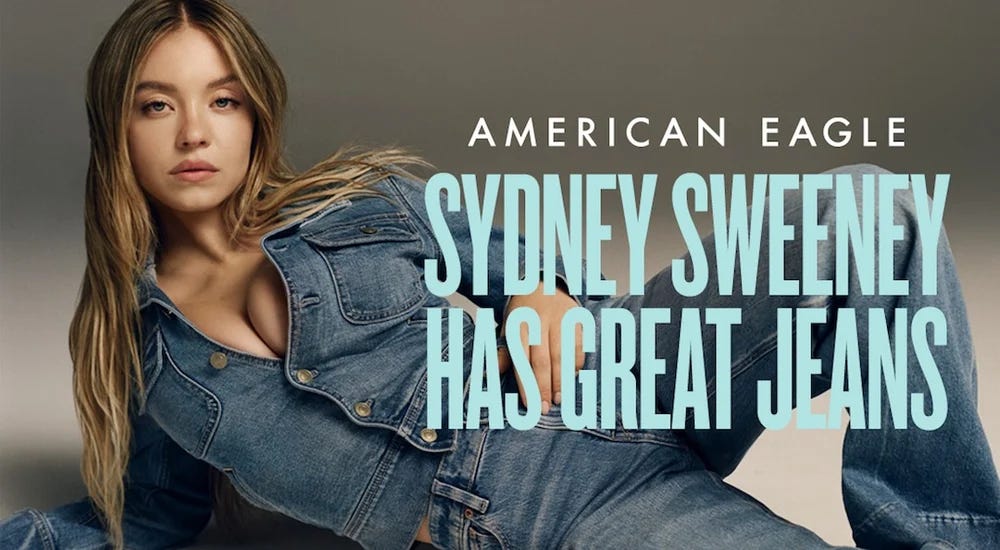
What the helleyonté?! Y'all come get your friend. Sydney Sweeney is out here talking about "genes being passed down" and "eye color" in American Eagle ads, and white supremacists in Arkansas are literally building a whites-only town. We gotta talk about White Utopias and how this coincides with our Romance TBR.
Oop- Not Eugenics Going Mainstream
Let's start with Sydney Sweeney casually discussing genetic inheritance in a jeans commercial. The ad has her saying, "Genes are passed down from parents to offspring, often determining traits like hair color, personality, and even eye color. My jeans are blue."
This is exactly how racial ideology gets normalized – through seemingly innocent conversations about "good genes" and inherited traits. It's what sociologist Pierre Bourdieu called "symbolic violence" in "Distinction" (1984) – the way dominant groups make their preferences seem natural and inevitable rather than socially constructed

Bourdieu showed that symbolic violence works by making arbitrary cultural preferences feel like natural laws. This is literally how racial science justified everything from slavery to immigration restrictions. The "innocent" slip from talking about blue jeans to blue eyes to inherited personality traits? That's not accidental. It's the pathway that leads from fashion advertising to ethnic nationalism.
The power of symbolic violence is that it doesn't require conscious intent. Follow me: Blue jeans → blue eyes → inherited traits → "good genes" → genetic hierarchy. Sydney doesn't have to be a white supremacist for her words to reinforce white supremacist logic. When blonde hair and blue eyes become associated with "quality," we've already stepped into eugenics territory.
In Arkansas: The Quiet Part Out Loud
While Sydney's doing Eugenicist Susan B Anthony’s Damadest for American Eagle, white supremacist Charlie Orwoll is building his dream community in Arkansas. RTTL (Return to Traditional Living) is 160 acres of "white Americans who value their ancestry," – and before you ask, yes, they require video calls to verify "ethnic identity" and explicitly ban Muslims, LGBTQ+ people, and non-Christians (except pagans, because apparently Norse mythology is acceptable white heritage).
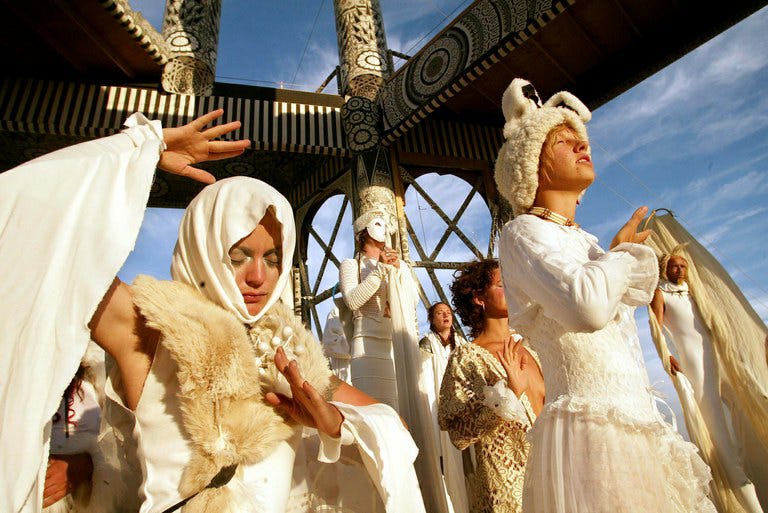
So what does it mean to build racially pure enclaves? These projects are attempts to create what Benedict Anderson called "imagined communities" – except instead of imagining inclusive nation-states, they're imagining exclusive racial territories. They're taking the fantasy of homogeneous safety that operates in our cultural imagination and making it literal. Arkansas white pioneer guy is just building the logical endpoint of ideas that already circulate in "respectable" forms – like genetic inheritance commercials and romance novel settings.
4 Romance Novel Types That Give White Utopia
Here's where it gets interesting for those of us who read romance: These white utopia fantasies are everywhere in our TBR piles.
Let's think through certain types of romances and where they are and what they represent:
Hockey Romances where everyone looks the same and shares the same values. The Hockey players are powerful, aggressive, sporty, but safely white as well.
Cowboy ranches where "traditional living" is romanticized – these erase Indigenous displacement, Black ranch labor and Mexican vaquero origins to create fantasies of white frontier life.
Mafia families where "bloodlines" and "heritage" determine everything – these romanticize ethnic insularity and blood purity as loyalty and family values.
Small towns where the biggest conflict is whether the coffee shop will close, not systemic racism – these imagine spaces where social problems are individual and economic, never structural or racial.
As Toni Morrison explained in "Playing in the Dark" (1992), white American literature has long used geographical and social isolation to explore white identity without having to confront its relationship to Blackness. These romance settings do the same thing – they create spaces where whiteness can be the default without having to acknowledge what it's defaulting from.
The Anthropology of "Safe Spaces"
What connects Sydney Sweeney's gene talk to Arkansas compounds to small-town romances is the fantasy of homogeneous safety. The idea that if everyone looks the same, thinks the same, and comes from the same background, life will be peaceful and harmonious.
But here's the gag: Homogeneity has never protected anyone from barbarism.
Lynchings happened in small, tight-knit American communities where everyone knew each other. The Rwandan genocide happened between people who shared language, culture, and centuries of history. Palestinian babies are starving in Gaza while Israeli settlers – who share ethnic, religious, and regional ties -participate in or support policies that create this suffering. Both Palestinians and Israelis are Semitic peoples who share ancient Middle Eastern origins, speak related languages, and have lived in the same geographic region for millennia. The violence between them isn't about fundamental cultural differénce – it's about how political power constructs and weaponizes small distinctions into justifications for dehumanization. The idea that ethnic or religious homogeneity creates moral behavior is not just wrong; it's often the precondition for the worst violence.
As sociologist Zygmunt Bauman demonstrated in "Modernity and the Holocaust" (1989), proximity and similarity don't create morality – they often make violence more efficient.
Bourdieu and the Taste for Purity
Pierre Bourdieu's work on "distinction" explains exactly what's happening here. In his research, he showed how dominant groups create aesthetic and cultural preferences that seem like "good taste" but actually function as exclusion mechanisms.
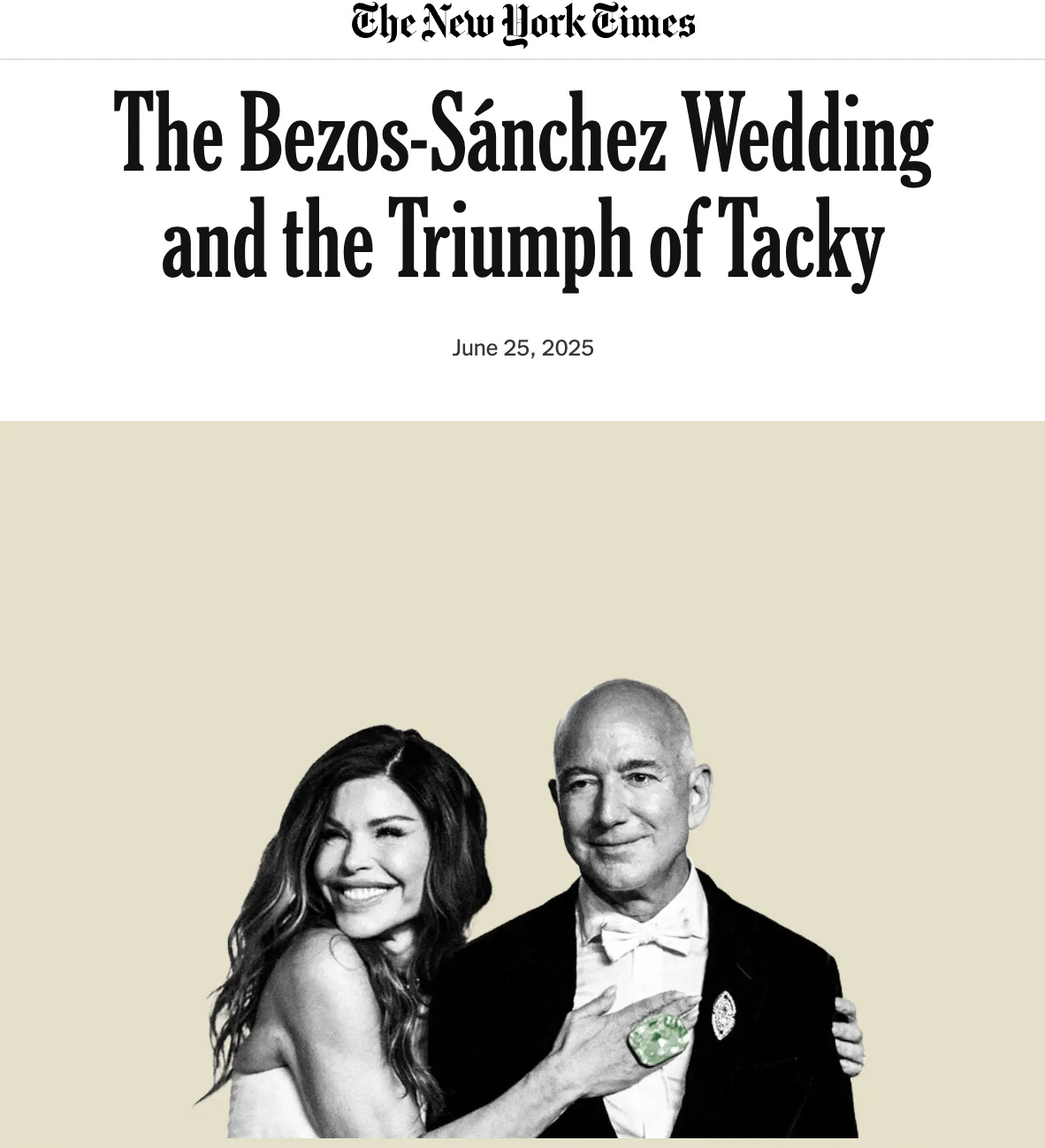
Take the recent discourse around Jeff Bezos and Lauren Sánchez's wedding coverage in The New York Times. The headline "The Bezos-Sánchez Wedding and the Triumph of Tacky" reveals exactly how taste functions as a weapon. When the Times calls their wedding "tacky," They're using taste to maintain class boundaries, suggesting that even extreme wealth can't buy you into the cultural elite if you don't perform the right kind of sophistication.
The genius of this system is that it allows old money to maintain superiority over new money, and it teaches everyone else where they fit in the hierarchy. When people debate whether Bezos's wedding was "tacky" or "fabulous," they're actually debating who gets to define legitimate culture. And notice who wins that debate: it's always the people who already have cultural power.
Bourdieu demonstrated that what we call "taste" is actually a sophisticated social weapon. When romance readers gravitate toward certain settings – the quaint small town, the exclusive hockey team, the "traditional" ranch – they're not just choosing entertainment. They're participating in what he called "the aestheticization of politics." Cultural preferences that feel like personal choices are actually collective boundary-making processes.
The genius of this system is that it operates through pleasure rather than coercion. Nobody forces you to prefer small-town romances over urban ones, but when small-town settings consistently code as "wholesome," "authentic," and "romantic" while urban settings code as "complicated," "dangerous," or "political," you're being trained to associate homogeneity with happiness. Just like nobody forces you to think Bezos's wedding is tacky, but the cultural apparatus that shapes taste has already taught you what "class" looks like – and it's not loud, it's not new money, and it's definitely not Latina excess.
But here's the thing Bourdieu understood: These distinctions are made of vapor. The differences between "us" and "them" that feel so significant – the eye color, the family trees, the "shared values" – are socially constructed categories that change depending on who's in power.
Why This Matters for Romance Readers
I'm not saying everyone who enjoys small-town romance is secretly plotting white supremacy. But I am saying we need to examine why these settings feel "safe" and "romantic" to so many readers.
When we romanticize spaces where everyone shares the same background, speaks the same way, and faces the same (usually economic) problems, we're participating in the same fantasy that drives both Arkansas compounds and gene-talk advertising campaigns.
The fantasy that homogeneity equals harmony.
The Anthropological Reality Check
Here's what anthropology actually tells us about human communities:
Diversity creates resilience, not conflict
Homogeneous societies are more vulnerable to collapse, not more stable
The most innovative and adaptable communities are those with the most internal variation
This survives

This Dies
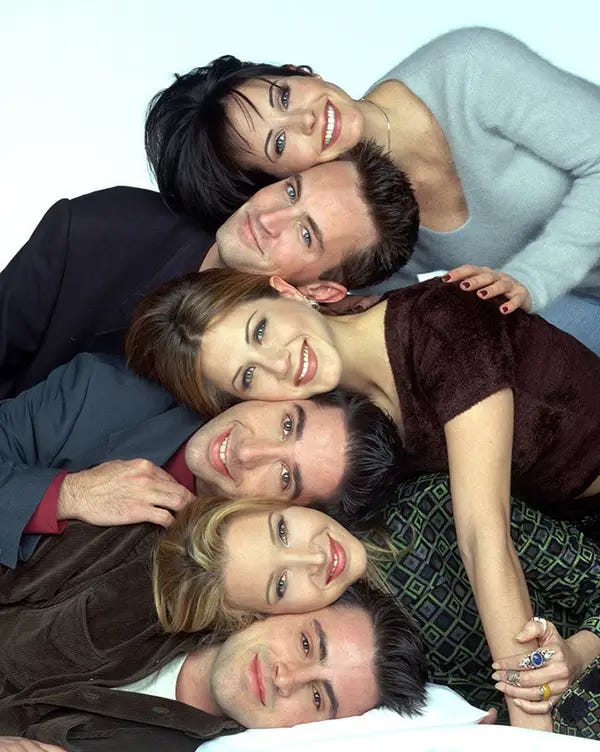
When societies try to create artificial homogeneity by excluding difference (like Arkansas compounds or romance novel small towns), they become brittle because they've eliminated the very variation that helps communities adapt to change. Seemingly homogeneous societies like China's resilience comes partly from absorbing and incorporating differences rather than expelling them – though this process has its own violences and contradictions.
The most innovative and adaptable communities tend to be those with significant internal variation – think of how migration and cultural mixing have driven innovation in cities like New York, London, or Dubai.
The Romance Novel Problem: When romance novels imagine "safe" homogeneous communities, they're not fantasizing about China's complex unity-in-diversity. They're on that Arkansas-style exclusion spaces where difference has been expelled rather than integrated.
When we choose entertainment that imagines away complexity in favor of artificial simplicity, we're rehearsing what a world without "complications" (read: other people) might look like..
OK, Killjoy, What Do We Do?
I'm not calling for boycotts or book burnings. But I am calling for conscious consumption. When you pick up that small-town romance or hockey love story, ask yourself:
Who's missing from this "community"?
What kind of "tradition" is being romanticized?
Why does this setting feel "safe" to me?
I am not going to yuck anyone's yum. My Kindle will be burned when I die🔥. But we can be curious about why we like what we like.
When we understand that our "innocent" entertainment choices are connected to larger cultural patterns, we can make more conscious decisions about what fantasies we want to feed. Do we want to keep rehearsing stories where safety requires sameness? Or can we imagine love stories that find safety in solidarity across difference?
Listen…Sydney Sweeney's “Blue genes” talk and Arkansas’s whites-only compound are selling the same fantasy: that similarity equals safety, that purity equals peace, and that love is best when it looks like you.
But anthropology – and history – tell us a different story. The most beautiful, lasting, and transformative love stories happen when people choose each other across difference, not because of sameness.
Share this with: a Swoontellectual who examines their TBR, romance authors writing big, diverse worlds, and book clubs ready for real talk.
Try reading: Stories where love happens across difference, not despite it. Your romance novels can reflect that reality, or they can continue to sell you Arkansas.
Choose accordingly.
Sources:
Bourdieu, Pierre (1984) "Distinction: A Social Critique of the Judgement of Taste"
Morrison, Toni (1992) "Playing in the Dark: Whiteness and the Literary Imagination"
Bauman, Zygmunt (1989) "Modernity and the Holocaust"
I love Ashley. She writes such big, big, interesting worlds
I love your brain.